How could I NOT write about this? Here’s my latest article on Bernanke at policymic.
Bernanke Keeps the QE going.
Markets act surprised! I’m surprised markets are surprised. Bernanke spent the last few months transmitting a message “taper will be data-driven, get it, guys? I repeat – data-driven!”
All the doomsday pundits out there need to take reading comprehension test.
My New Article on Government Shutdown.
At policymic.
While a threat of default is very real with our dysfunctional Congress, very few are under the illusion that a default would happen due to a real U.S. insolvency. It’s not that the U.S. can’t pay up, it’s that the mechanism for sending the checks is broken. Apparently, this is enough for investors to be sanguine about U.S. debt.
What if a Personal Initiative is Destructive?
As I was translating that article, I realized how encompassing that idea of modern day feudalism is. If it’s everyone for himself, both politically and economically, what kind of freedom are we talking about?
Modern day GOP is a great example of such an ideology: Fuck everybody! If we don’t get what we want we just bomb everything. Because our idea of disruption matters just as much as the others’ idea of cooperation. Why shouldn’t it be awarded the same weight? We’re a democracy, after all. But what we get is a perpetual animosity.
It is declared that such multitude of voices will be mediated by a personal initiative, by economic progress. Well, Walter White (I’m still stunned after yesterday’s Breaking Bad episode) has a personal initiative when faced with his own mortality. In some sense, in a current predicament we’re all Walter Whites – left to own own devices, advised to fend for ourselves the best we can. Who is to say that a personal initiative will necessarily be constructive? What’s to stop us, when we’re pressed against an economic wall, from becoming our own little GOPs, from becoming metaphorical meth cooks? No matter – says the free market. It will be dealt with by an invisible hand of the market. If you’re bad you will perish. Really? Republicans have been behaving like little children for years and not only they’re expected to hold the House, some even think they will get hold of the Senate next year. If “democracy-free markets” construct rewards the initiative, it doesn’t exactly specify what kind of initiative. Malicious and destructive? Who cares, as long as it’s an initiative, as long as a person or an entity gets to act in its own interest.
Democracy in Flames (Part II)
The second part of this article is too meta, I had to look up some references and names.
But it’s too profound, nonetheless.
Part II
Democratic nomenclature doesn’t necessarily resemble socialist nomenclature of Brezhnev times, thoroughly described and rejected. The factory directors who became district party leaders – we all knew that nomenclature but that’s not what we’re talking about today. These are not textbook capitalists, exploiters of the working class – the way they are critiqued from the left. New democratic nomenclature only marginally represents the interest of the right, this ideology is not inherently right-wing. What’s important is that so-called left-wing views are represented in this new nomenclature together with the right-wing, and left-wing language is present in this new ideology as an ornament. Hannah Arendt does not contradict Ayn Rand, but sort of embellishes her; these two dames represent the new ideology with equal passion. Modern ideology – and this is important – is built with the use of so-called left discourse; it is based on the understanding of avant-garde that was carried by left-wing thinkers, it operates with notions of radical art; it has its own, non-classical, non-categorical philosophy; it has its own non-conservative values system. To accept this ideology as a whole – which is the only way to grasp this concept: Deyneka and Simonov can’t be separated from the brief history of Communist Party (of Bolsheviks) – one can be convinced that it is not a classical conservative doctrine. The values system of the new ideology is served by avant-garde, objectless art, leftist curators; and, technically left-wing Slavoj Zizek contributes for this new ideology in no less than technically right-wing Cheney and Rumsfeld: they are all in service of the new doctrine. The class system of the new order, created by the democratic markets, this new democratic nomenclature is a class of freedom lovers, proponents of personal freedom for all. The fact that its representatives turn out to be feudalists does not negate their progressive views – they believe in freedom and personal development. They don’t want to subjugate anybody, they just can’t do anything about it. Today the ideology of democratic nomenclature presents the most progressive teachings. The citizens got convinced that the presence of the rich feudalists symbolizes their own freedoms; many believed this, thousands of journalists prove this state of affairs every day. And the feudalists themselves believe that they sow goodwill.
Democracy in Flames (Part I)
I’m so fascinated by this article that I decided to translate it in full.
Here’s part 1:
By Maxim Kantor.
We live in strange times, where there are many who are scared of the word “democracy”. It is impossible to bring a hundred cultures to the common denominator, but it very easy to start a worldwide fire. War today is the only order, the only desirable status quo for the democratic nomenclature. As such, the desirable result of war is not surrender of the enemy, but a continuous animosity.
A war is expected in acquiescence. It’s not about any specific reason in any specific country. If there’s no war in Syria, it will happen in some other place. Wars transcend boundaries with the same ease as capital. War transaction is executed as easy as a bank transaction, and it’s impossible to keep track of who gets the profits. It’s customary to say that the US gets the profits. But it’s a conditional fallacy. The wars of today are different – not the kind we read about in textbooks. And the benefits of these wars are different.
Absolutist conditions (armies adhering to conventional warfare) have long ceased to be observed. Napoleon wanted a duel, but received a dirty rout; but the goals of war remained the same – to win. Today the goals are different. The desideratum result of war is not victory over an enemy, but the continuous animosity.
Democracy in Flames
It’s been a while since I read such a thorough and thoughtful critique of current political and social predicament. Unfortunately, it’s in Russian. But I will translate an especially poignant paragraph:
The peculiarity of our current historical fragment is that democracy equates itself with free market; today, democracy is dependent on competitive triumph of the strong over the weak. Democracy declares victory of success over failure as its achievement. Competition per se is not the problem: every participant, however strong, has a chance to win. But what makes these particular triumphs different, from, let’s say, the triumphs of Pericles, is that a society doesn’t win from the victories of the strong. The subject of Pericles’ democracy or Jeffersonian democracy was society, and not some particular outcome of a competition. Today’s society – is a stage for a free market; people are spectators at best, but rather a hindrance to the competition. In theory, democracy does not allow for the triumph of the strong over the weak: such triumph happens in the course of a competition; it is moderated by the rights of other citizens – the strong is dependent on society where he shares the responsibilities of citizenship. But the hybrid of the last decades – “democracy – free market” – cements the victory over the weak as something permanent, creates a caste of “super citizens”, the strongest players, citizens of global market – but not citizens of a particular society. The successful are automatically becoming powerful political force; and not in any given stand-alone country – since the market is not subject to boundaries. Banks’ CEOs, heads of corporations, owners of natural resources companies do not represent society; they don’t even represent their own capital – they represent the new formation, new democratic nomenclature.
I’ll file it under “deep thoughts”. For my Russian readers – a great long weekend read. Maybe I’ll translate more later. This needs to get bigger circulation.
Bond Vigilantes’ Rage is Misplaced
As many of you know I always wondered about how the supposedly brilliant “bond vigilantes” have missed the biggest gorilla in the room – Bernanke. Well, they did and it bugs them BIG TIME. It wasn’t supposed to be that way, but that’s what happened. So rather than being a little introspective, they blame a guy who had access to certain tools and, gasp(!), decided to use them. Now they’ve reached a point of such ideological fervor that they would rather bet against their positions, just to make a statement.
Why are the bond vigilantes purposely driving down the market value of their stock-in-trade, anyway? Part of the reason is ideological. They hate Bernanke as an interloper, and Obama for the same reason, so they are reluctant to believe that the economy is actually recovering under the leadership of those two faculty-lounge geeks.
The vigilantes are like the hedge fund guys who share the same ideological hates and have been (wrongly) shorting the stock market for several years. Now both the bond vigilantes and the hedgies see a chance to “get theirs” back — notice how the friends of hedge funds have quickly used the bond rate spikes to renew their cable TV calls for a deep stock price “correction” that will bail out the hedge funds and give them a chance to get back into the market on the cheap.
Fuck’em!
The London Whale Trade Scapegoats and What It Means for the Industry
If you’re a low-level employee at a financial firm, beware: you will not be spared if your bosses fuck up. In fact, your entire risk/reward is strongly skewed against you: you bonus is still meager (or non-existent), but your chance to be accused of wrongdoing is not commensurate with your compensation. Like that guy Julien Grout – a mere trading assistant who marked Iksil’s books and who is now facing charges on four counts. His bosses tell him how they’d like to see the positions marked and he goes ahead and delivers them the numbers they want to see. Bruno Iksil, his boss and the trader who put on those trades is not being charged. Instead, he’s cooperating with the authorities and ratting out his own boss and his trading assistant. The interesting part is that Grout, a low level employee who merely evaluated the desk’s P&L, devised a plan to get out of the position, before shit hit the fan, which would book about $500 mln in losses, but his bosses told him no thanks. And what are you going to do then? Are you going to do what your bosses tell you or run to the authorities? If answered honestly and with assessing all the upsides and downsides of either move, this question is easy to answer: you will do what your bosses tell you.
The sad part is that SEC might pump its chest and think it’s found its mojo. But the reality is such that if there’s an abundance of willing striving young men, dreaming of a career on Wall street, unable to say no to prospect of quick riches, there will always be room for such abuse. It is only the lack of willing soldiers lining up to take those ungrateful jobs that will, well, do the job. When there will be no cache of low-level employees willing to take such uneven risks and then being made scapegoats, this is the beginning of the end. This story is a good warning to all those young jocks dreaming of Wall Street: If your boss loses money and it makes headlines, he’s not going the one taking the heat – you will. Perhaps the next generation of Julien Grouts will pause before wishing for that job on the trading desk after all.
And then, what if it is physically impossible to be honest on Wall Street? The whole system is so corrupt that even a fair-minded person will end up contaminated while on the inside. When you’re a low-level employee you do what you do because you can’t say no to your boss. When you’re a mid-level employee you do what you do because there’s a big reward on the horizon – a promotion or a bonus. When you’re senior management you do what you do because you’re in the spotlight, sometimes sought, sometimes undesired.
None of those stages are welcoming to self-reflection. The pull of the flow, of the tide is so strong that it’s easier to just go with the flow. People have to stop wanting to do what they’re doing in order to bring changes to the entire system. Since neither government, nor legislators, nor regulators, nor public furor could do anything definitive to change the corrupt system, the system itself has to become unsustainable and collapse under its own weight. When I talk to my still surviving former comrades, many of them simply don’t want to do this anymore, they seek to leave the industry altogether. The pay sucks, the bonuses are zero, there’s more work to do with no reward, monetary or personal. When people refuse to be a part of it, not because they’re fair and civic-minded but because continuing to be a part of it goes against their own self-interest, that’s when there’s hope for any reform.
But we’re still far from it: You may hate your job that pays $200-250K base, but there’s nothing else out there that can pay that.
So, to use a zesty Russian expression to perfectly describe the predicament, Wall Street will continue to “fuck and cry”.
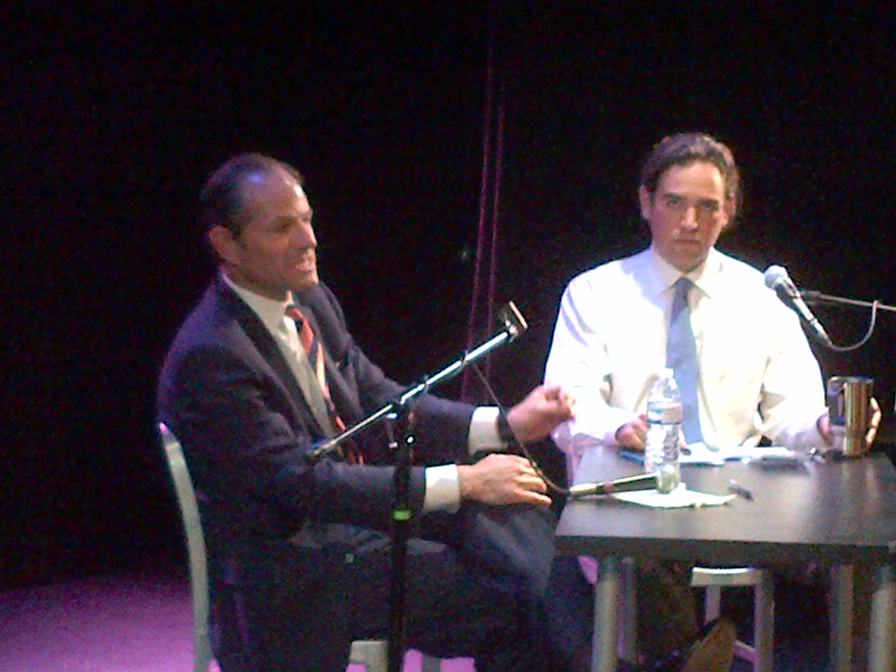
Stringer Spitzer Forum at the Tank
Last night’s forum at the Tank. Organized by DFNYC, Drinking Liberally and ACT NOW.
Stringer would be a good comptroller, but Spitzer will be a great comptroller. He just knows what’s going on. He understands the dynamics between pension funds and Wall Street on a very deep level. That’s the impression I got last night.
Thanks to Tracey and Justin from DFNYC for organizing a great event.
 Left with Balls