In defense of Ben Bernanke

A little belated analysis of the recent article in the Atlantic.

I find it amusing that I seem to be the only person who doesn’t dislike Bernanke.

Let me first list the reasons.

1.  Rates stayed low (and some who bet against it had acknowledge their mistake – e.g. Bill Gross), which led to the monthly payments on my arm mortgage to stay ridiculously low.

Continue reading

The Guy Who Left Goldman Sachs

I don’t know much about Goldman personally, other than that article by Matt Taibbi and now the letter. All I know is when I was trying to short ABX (a mortgage-backed index) in early 2007 Goldman had absolutely the worst bids, meaning they didn’t want to take the other side of the trade. That spoke volumes. They had the same axe I did! More recently, at a party, a person who didn’t know that I knew he worked at Goldman said that he worked at “a hedge fund”. And it’s not like I asked.

But a few thoughts on the letter and on the reaction. Reading the reaction the first thing I thought was that even while on the buy side I didn’t have enough time to read anything unrelated to work, let alone comment on it. At Goldman, by nature of it being the sell side, I assume, people work even harder thus having no time for and no access to social sites. Which, using further deduction, means that people posting derogatory comments about the guy do not and have never worked at Goldman. And if they do now they are not Goldman material and should be fired.

Furthermore, some commenters are upset that he slammed the door on the company that nurtured him, others are upset that his epiphany came a little too late. Some say that he was a nobody, a low-level employee, but the others say that it’s nice to slam the door when you’ve got enough money to never have to work again. So which is it? He cannot be all of the above. Frankly, I don’t think that a VP, even at Goldman, even after 12 years has enough to retire. So kudos to him there.

On the other hand it’s hard to ignore the nature of his disappointment. Goldman is in the business of making money, not saving the world. The daily routine for an average Wall Street worker is dull and unrewarding but it pays well. Perhaps, with his skills he would be better suited working for World Bank or the UN. To be well paid and receive satisfaction from your job – well, that’s too much to ask for these days. It’s either or. But he wanted both.

I saw some of those “Muppets” at the industry conferences – guys from pension funds and German banks. It’s not an inaccurate description at all. They wanted yield and they didn’t care how they got it. So Goldman and other banks provided. KYC (know you client) they did. If they didn’t give the client what he wanted he would have gone to another dealer – an anathema to any banker worth his keep! And it wasn’t illegal, and those were qualified institutional investors! And if they weren’t – it wasn’t Goldman’s fault. I’m not defending Goldman at all, I’m just describing a part of the larger environment that got the snowball rolling. Inept investors with billions to invest, smart Goldman bankers – it’s like two naked people in bed – what do you think was gonna happen?

Wall Street, as described in detail in many of my earlier posts, is a close-knit community with us vs. them mentality. Even more pronounced at Goldman I would think. Everybody outside is a loser, a non-entity. Greg Smith is outside now. I understand that Goldman as a company is not pleased with whistleblower like him. But I don’t understand why laymen are angry at the guy. I think what he did is a good exercise of free will – leaving Goldman with a slam of the door. He may be mistaken about some things but he’s not without balls.

On Women’s Issues

One is not born a woman, but becomes one. Simone de Beauvoir

In more than 140 posts on this blog this is my first “women’s issues” post as this is not my favorite topic. But the current political environment makes it impossible not to add my two cents to the debates. So, here goes.

To begin, this is the video of little girl being upset about gender stereotypes. It serves as a good example that one is not a woman when born but made into one later.

Continue reading

Free Market vs. Conservative Moralists

“A God who rewards and punishes is inconceivable for the simple reason that a man’s actions are determined by necessity, external and internal, so that in God’s eyes he cannot be responsible, any more than an inanimate object is responsible for the motions it undergoes. A man’s ethical behavior should be based effectually on sympathy, education and social ties and needs; no religious basis is necessary.” Albert Einstein

For an average American the economic reality is increasingly dual – you’re either on the working “treadmill” running faster and faster or you’re a bum, and there are few choices in between. Some people work longer hours for less pay, while others can’t get a job at all.

The praise on the right of the current economic system of “treadmill” lifestyle does not fit well with their demands of the return of traditional values. Let’s assume that we magically return to the desired “nuclear family” era that the right so nostalgically revere. If only we work harder we will become more moral, the thinking goes.  Such a family would immediately drop out of the treadmill participation simply because the middle class has long been relying on two person incomes, not one.

Continue reading

Conservative Mind Expansion

An average conservative head is a complete mess these days. But it’s a creative mess. They have learned so many new words and names and concepts they haven’t heard of before and are so eager to share their newfound knowledge that they remind me of a teenager who has just discovered Nietzsche. They walk around dispensing words like socialism, Marxism, Objectivism, anti-colonialism, quoting Friedrich Hayek, Ayn Rand, Milton Friedman and even Saul Alinsky. But I commend them for the mere curiosity and interest in learning new things.  Why shouldn’t we celebrate when the unassuming inhabitants of Midwestern and Southern towns are now conversing in terms that you would otherwise hear at a preppy College Libertarians soiree?

Continue reading

The Spell of Wall Street

“Seek first to understand then be understood.” Anonymous.

Understanding Wall Street mentality is a bit like understanding military mentality. There’s something utterly profound when brothers in arms pull together in the heat of battle and persevere. Wall Street fancies itself to be like the military. The place is rich soil for military quotes and references and “war stories”. Making money in adverse conditions is viewed as an act of valor, a display of incredible courage. Many in a decision-making position have “killed” or “been killed” at least once. Continue reading

Honest Conservatives

It is possible, although decreasingly so in American politics, to admire, if disagree with, your political opponents. I keep a dwindling collection of conservatives, who are not preoccupied with vengeance, destruction, pledges and sexual politics. I call them thinking conservatives and perhaps the matters where we disagree would come down to economics and foreign policy. David Frum is on that list, so is David Brooks. William Buckley, the lucid founder of conservative magazine National Review, whose son Christopher Buckley famously left his father’s venue and voted for Obama in 2008, was a pleasure to read before he passed away, if not for agreement but for his deft command of English. I can hardly imagine a current day conservative to publicly criticize Ayn Rand, as well as denounce John Birch Society as “far removed from common sense”. Who does the Right have now to carry the torch – Rush Limbaugh? Charles Krauthammer? It’s beyond embarrassing! Continue reading

New Year Resolutions

“The way I learned it, the kid in the school yard who doesn’t want to fight always leaves with a black eye. If you indicate you’ll do anything to avoid trouble, that’s when you get trouble.” 50 Cent

As a rule, New Year’s resolutions are not directed at others but projected onto ourselves in an attempt to become better in the coming year.  Thus, I will indulge myself in some inward-looking (in a collective sense) narrative.

Perhaps you are already familiar with the idea that the Left in general, while having the best argument, is weak to defend it. In an attempt to find a cure to this ailment, I first had to identify the source of the disease, and I can’t find a better explanation than the desire of liberals to “be nice”. This image of the Left, as going to great lengths to “be nice” and not to offend anybody, morphs into justifiable belief that liberals can’t fight for their values.  “Being nice” manifests itself in many ways, including using reason when a show of force would be more effective, fighting for minor issues, like bike lane rights, when voting rights are being undermined in broad daylight, and taking offense at being called names while democracy is being undercut by unfair redistricting. Continue reading

A Party without Judgment

Capt. Willard: “They told me that you had gone totally insane, and that your methods were unsound.”

Col. Kurtz: “I remember when I was with Special Forces… seems a thousand centuries ago. We went into a camp to inoculate some children. We left the camp after we had inoculated the children for polio, and this old man came running after us and he was crying. He couldn’t see. We went back there, and they had come and hacked off every inoculated arm. There they were in a pile. A pile of little arms. And I remember… I… I… I cried, I wept like some grandmother. … And then I realized they were stronger than we, because they could stand that these were not monsters, these were men… trained cadres. … If I had ten divisions of those men, our troubles here would be over very quickly. You have to have men who are moral… and at the same time who are able to utilize their primordial instincts to kill without feeling… without passion… without judgment… without judgment! Because it’s judgment that defeats us.”

John Milius & Francis Ford Coppola, Apocalypse Now.


I remember how in the run up to a debt ceiling debate last summer I wrote on my wall: “In the battle between the Tea Party and Wall Street I’m betting on Wall Street.” How naïve I was back then. How much faith I put, wishfully, into Republicans’ supposed concerns for other people’s hard earned money. How much weight I gave to the notion that Republicans will put business interests, money and fiscal responsibility first. How much significance I assigned to the bond between Wall Street and Republicans. In my head I had pictures of Wall Street moguls frantically dialing their buddies in Congress, saying: dude, look, I understand you hate Obama and stuff, but I have a huge position in this and that, you have to pass this, I don’t care about politics – just pass the damn thing! That was my bet. I lost, of course. I underestimated the will of the Republicans to cut off the arms of little children if it meant victory. Continue reading

Why Play a Rigged Game?

Poker is my religion. There are rules, upon violation of which, you get punished mercilessly. Some call it statistics, some – including myself – poker Gods.

When I sit down at the table I appreciate the plethora of characters from all walks of life. I appreciate the fact that there are winners and losers, luck and grind, spectacular twists of fate, rivalries but also universal fairness: In the long run, if you play correctly, you win. Very American Dream, isn’t it? There are quiet types you have to watch out for, business travelers, retirees, smelly hobos, students and “just passing by” types. There are also administrators of the entire establishment including dealers, floor managers, security that derive their sustenance from players; and an element of game – a deck of cards that is changed every few hours. You get my drift – just like a democracy. Except that we’ve been playing with the same stacked deck for the last few decades. Some people at the table will never get dealt two kings or two aces and it is not chance related. Others, who consistently win at the table make me wonder – have they really become so much smarter, savvier and better at math to beat the odds in such a remarkable manner? Am I to believe that some players are now so much sharper and more productive than they were 30 years ago, thus deserving not 20 times but 300 times the payouts of an average Joe Schmo?
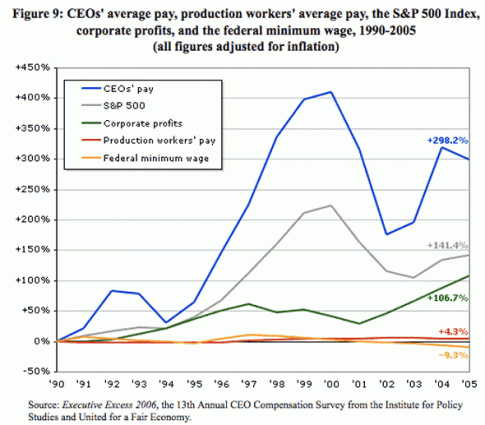
That’s some impressive margin of error! So a hobo-looking character and a few students at the table complain about it and demand a new deck. And predictably, “good players” immediately jump in and attack them for being losers and comment on their personal hygiene. I wonder why – are they in on it? The sad truth is – correct play is no longer a guarantee against a long-term loss at this poker table of ours. And, if you don’t want to award any credibility to dirty hippies for voicing it, then who’s to know that better if not hundreds of thousands of people laid off from financial industry in the wake of the financial crisis. They played correct, solid game – they went to college, worked hard, got a mortgage, paid taxes and still got run over. Just look at the headlines from the last few days:

“Finance Job Losses Near 200,000 as BNP, Citigroup Cut Staff

Commerzbank sinks to first quarterly loss since ’09 and begins lending pull-back

UBS plans to cut 2,000 investment banking jobs

More heads roll in 2011 than in 2009

BNP Paribas to lay off 1,396 as crisis deepens” (Source: Options Group, Fins.com)

The first, and understandable, reaction of those laid off is to blame government regulation that encumbers the normal flow of business. If the government wasn’t pressuring banks to comply with strict rules those people would not have been laid off, the logic goes. While this can be somewhat true in the short term, are those people prepared to endure boom and bust business model in the future? And, more importantly, do they want to continue to play the game where the odds are against them, no matter how good their skills are? Guys, it’s been a juicy game at the table, no doubt, but not for you. Because to have a comfortable, middle-class life in Manhattan (not lavish, just comfortable!) you have to be a Managing Director at a Wall Street firm, but there’s simply not enough facility to accommodate everyone to become one. So what is the rest, the middle of the Bell curve with just college degree, strong work ethic and no delusions of grandeur supposed to do? Why is comfortable, middle-class life increasingly becoming a luxury available only to super achievers?

This juicy table is on the brink of breaking as more and more players are saying – we don’t want to play this game.

Those who think that OWS are anti-capitalists, iphone-using, Starbucks-drinking hypocrites and society leeches demanding handouts could not be further from the truth. “Get a Job” signs, while prompting self-satisfied chuckle in the Fox News crowd for being “clever”, fall flat. Those protesters would love to get a job but they can’t. Why is it that thousands upon thousands who lost jobs on Wall Street following the crisis deserve sympathy and the unemployed protesters don’t?

All they want is a new deck of cards. To clarify what I consider a new deck of cards is (just to start, in no particular order): reinstatement of Glass Steagall Act; effective government regulation (not necessarily more and not necessarily stricter – effective); enactment of Volcker Rule; a bailout fund sponsored by a tax on corporations to save themselves should shit hit the fan again; stricter regulation of credit-default swaps – you can buy protection only on the asset you own; executive compensation regulation. The latter is controversial and I would support a legislation that regulates the payouts of CEOs of deposit-taking institutions. If it’s a hedge fund that trades its’ own money – knock yourself out. But there’s no amount of stress and hard work that I can think of that would justify $68mln payout (Lloyd Blankfein compensation for 2007) for a bank CEO. Tough decisions to make, thousands of people to manage, sleepless nights, erectile dysfunction – fine – but unless you played with your own money and took your own risks and your downside is that you lose it all, move to the projects and dodge collectors – it’s not worth $68 bucks. Commanders in Iraq are under more stress and have to make decisions with lives, not money – for what a typical CEO considers change.

Americans love a good underdog story and often see Rocky or Billy Beane in themselves. That’s commendable, but under the current rules Rockys will be perpetually dragging that log and Billy Beanes will be perpetually tweaking those metrics with only a promise of a win in sight. I too love the element of competition and game in life, but to stay and play at that table would not make me a hero – it would make me a fool.