Do fines even work?

When someone sets aside $6.8 bn  just to pay fines, are they really scared of fines? Do fines and financial settlements even matter anymore? That kind of stash, that nowadays any self-respecting bank sets aside, is just a regular expense, a price of doing business. Isn’t it a time to think of some new recourse, like jail time and/or mandatory breaking of institutions into smaller parts?

Although, it’s not clear who would go to jail. So that leaves one option: break-up TBTF – not as a prophylactic measure, but as price for wrongful behavior.

Another Glaring Inconsistency in Right-Wing Thinking

In his recent article conservative intellectual Thomas Sowell explores left-wing ideology shortcomings.

At least as far back as the 18th century, the left has struggled to avoid facing  the plain fact of evil — that some people simply choose to do things that they  know to be wrong when they do them. Every kind of excuse, from poverty to an  unhappy childhood, is used by the left to explain and excuse evil.

Before I even read further an obvious retort popped into my mind: If people are so evil then how can this kind of mindset reconcile with the free-market ideology which the very same conservative camp promotes under the idea of rationality. Can people be irrational when it comes to social behavior and then suddenly become rational when it comes to making economic decisions?

Why has evil been such a hard concept for many on the left to accept? The basic  agenda of the left is to change external conditions. But what if the problem is  internal? What if the real problem is the cussedness of human beings?

I’m on the Left and I accept evil, and I recognize that people will do evil things just because they can, regardless of their difficult childhood or any hardships. So why then are we supposed to assume a laissez faire posture when it comes to guns and markets. Aren’t these the very people who can’t engage in self-control, in self-discipline, in self-policing? Or, does Thomas Sowell imply that there are two different sets of people – ones that warrant the social control mechanisms (ghetto folk) and the ones who don’t (financial industry)?

And then he steers into the usual conservative talking points about the degradation of family and sex life.

I’m almost embarrassed for Thomas Sowell. I watched his appearance in the 1970s (on Youtube obviously) on the Firing Lane – the late William F. Buckley’s political debate show, the kind of high-brow intellectual discussions that don’t exist anymore. I was impressed with what he was saying, how he was saying it (the topic was Affirmative Actions) and I did not find him unreasonable at all. He got me thinking. And now this.

It’s sad to see an intellectual turn into a shill.

Why I’m not a Republican

Russian community in the US is known for its right-leaning and at times even reactionary political views. A few days ago an old acquaintance, a Russian émigré, told me: “I don’t understand how you, after all you’ve been through, are not a Republican.”

It’s not that I haven’t thought about it before, but I never had a chance to put my thoughts in writing. Until now.

I guess my antipathy towards GOP originated during the Clinton years, when I was genuinely puzzled about the witch hunt that Republican Congress unleashed on Clinton. I couldn’t figure out what was the big deal, but the more I read about it and watched the news the more it became apparent to me that it’s not about the blowjob at all, and not even about him lying about it under oath. There was something sinister and vile about the whole investigation, the furtive desire to destroy Clinton and his entire Presidency, the malice, the glee with which they attacked him. I found it appalling. My Democratic foundation has been firmly planted by those events.

Continue reading

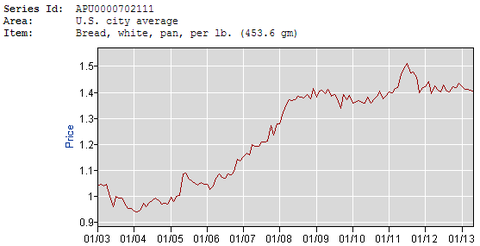
Let’s Put Inflation Argument to Rest.

Let’s put the inflation argument to rest. I don’t know how many times I pointed out on this blog about inflation non-existence, it keeps coming up in various oped pieces.

Here’s the price of a gallon of milk:

062613krugman2-blog480milk

And here’s the price of a loaf of bread:

062613krugman1-blogbread

From here.

More on Charities.

Next time you’re about to make a donation to some charity read this article.

Carol Smith still gets angry when she remembers the box that arrived by mail for her dying husband.

Cancer Fund of America sent it when he was diagnosed with lung cancer six years ago. Smith had called the charity for help.

“It was filled with paper plates, cups, napkins and kids’ toys,” the 67-year-old Knoxville, Tenn., resident said. “My husband looked like somebody slapped him in the face.

“I just threw it in the trash.”

Just to follow up on my previous article on charities.

The Problem with Charity

There’s been a number of articles lately, exploring charitable impulses of the rich and powerful. There was one article describing people deliberately picking high-paying jobs so that he can give money to charity.

I think such people are self-deluded. Moreover, I think that modern day charities with its black-tie galas and names attached to the donated amounts are simply great tools for self-promotion. Felix Salmon has a similar idea about charities. In short, it’s all bullshit designed to make a giver feel important.

When I was several years into my career on Wall Street and when a certain career trajectory, routine and expectations have set in and certain goalposts have been achieved, I, as I’m sure many thinking, self-aware people at this stage, began to think what’s the point of all of this? Why am I doing what I’m doing and if this is all about money what would I do if I had enough in the bank to not have to work again? A thought of a passive retirement and a move to warmer climates was depressing and nauseating. One can’t just switch from combative and aggressive mental disposition – a Wall Street unspoken desideratum that takes years to nurture and develop – to a laid-back beach bum, hippie worldview. That kind of mental switch just doesn’t exist, not for Wall Street breed anyway. Ideally, I thought, it would be nice to open and run a charity with an asset-management arm. Charitable impulse is a natural evolution path for a seasoned and somewhat jaded and battle-weary Wall Street professional who would like to think of self as a progressive, benevolent and a good-hearted person deep inside. That’s what I thought of myself. However, a sober observation of industry and its business model would compel an honest and introspective person to question the “allocating assets and providing liquidity” rationalization, a popular line of defense among financial professionals justifying their existence to Main Street. This is where, for many, the urge to show the world one’s better side begins to kick in, and it is manifested in an attempt at making obscene amount of money now, so one can demonstrate his generosity and good nature later. I remember the mood on the street back in 2007: many felt something very ugly was coming and wanted to exploit the market to the fullest in order to set themselves up financially, just in case. The worse the things became, and even though I had the right trade on, the more I became burdened with the emptiness of the whole exercise, perhaps even the public damage, however small or indirect, of my actions. With the tools at my disposal (certain synthetic indices) I wasn’t “providing liquidity”, and I wasn’t helping businesses “raise capital”, I was merely placing a bet as one would in a casino with someone else’s money. Thoughts of future charity provided poor refuge: are the people whom I would potentially target with my benevolence – the disadvantaged kids, the poor girls in need of a scholarship, the hungry, the homeless – the very people I’m, however indirectly, fleecing now? Many on Wall Street could easily disassociate the two sides of the same coin – either by willful ignorance or a set of self-rationalizations or a mental block. I tried very hard to do that myself. For Christ sake, my entire career and by extension my entire personality was vested in this industry, the decade of long hours, wasted weekends, all-nighters, personal life structured around work, forgotten hobbies and interests – how could I not seek a justification for my sacrifices and hard work? But there came a point where I couldn’t convince myself anymore.

Those who successfully separate those two sides of the coin but still maintain and cultivate a hint of humanistic streak throw themselves into the charity circle. It is usual for people celebrated for their ruthlessness to want to show their kind and generous side at an opportune time. But let’s be honest: charities depend on whims and moods of the powerful and the powerful tend to be more interested in preserving their legacy by giving $100mln donations to business schools and art causes, than in sponsoring a soup kitchen or a homeless shelter. Those that need charity the most are simply not good at providing Kodak moment opportunity.

I don’t think I’m alone and I’m not the first in thinking about charity from this angle, but perhaps many don’t have much time to put further thought into it: why there are increasing number of people and causes that need charitable help? Why such misallocation of resources in the first place? Food for thought for the powerful and benevolent.

About Those Rising Interest Rates

I’m in a bit of a wonkish mood today. Last week bond yields have risen to the highest levels in about a year, thus making market participants nervous, thinking “is this it?”. Some in the “inflation is bad and imminent” camp are probably ready to pop Champaign bottles open to celebrate the long (very long indeed) awaited arrival of inflation and a vindication of their self-imposed black-and-white view of the world. But let’s examine two obvious questions: 1. Is inflation indeed already here? and 2. Is it as bad as they say?

First, the whole purpose of the much-derided Bernanke’s QE exercise is to spur growth: that’s what the Fed does when the economy is slow – cuts and keeps the interests rate as low as possible for as long as the economy is weak. The widely used indicator that the growth is back is inflation: if we begin to spot rising prices it means the economy is recovering (people find employment, consumers back in the stores, driving prices up). This is a far cry from Zimbabwe or Weimar Republic hyperinflation which is what alarmists have in mind when they say “inflation”.

Second, and this is an extension of the previous point – inflation is not always bad, precisely because it indicates a growing economy. It’s all about the range: 2% inflation is too low, Bernanke and his Fed colleagues would probably like to see it in the 4-5% range, 7-8% would probably warrant a tightening action from the Fed (rising rates, this is what Paul Volcker famously did in the early 80s). Yes, the Fed wants to see real, consumer-driven inflation rising, which of course doesn’t mean it wants to see it rising forever. Fed’s actions at keeping interest rates low are intended for a pick-up in business activity (making it cheap to borrow and consume or start a business), thus inflation is not seen as a negative side-effect that everyone should fear, but instead an intended and positive consequence of QE.

This is where many people get confused: Bernanke is pushing down rates in order to see them rise? In a sense, yes. Here’s a good summary:

“In a nutshell, that’s the QE conundrum. Central banks argue that their bond purchases are meant to push down yields in order to make long term finance cheaper. But, at the same time, a sign that QE’s working is rising yields.”

10-year Treasury yields have risen to 2.25% recently, highest in a year, which many say is some kind of dangerous threshold. Bond traders are especially jittery and here’s why (now I’ll get really wonkish, but if you do read on I promise to make it exciting if you remember one thing: when bond prices rise, interest rates decrease; and vice versa, if bond prices fall the interest rates rise): Many of the bond portfolio managers are holding huge portfolios of agency mortgages. Those mortgages are primarily fixed-rate – they pay a fixed coupon. If interest rates rise, like they did in the past few weeks, it means that homeowners holding those mortgages suddenly pay a lesser (in relative terms) interest rates than the market and thus are less likely to refinance. Because those people are less likely to refinance, our bond managers are stuck with their portfolios of mortgages that pay less than they could get in the market today. On top of that, because people are not refinancing, it forces bond managers to hold those losing bonds longer (it’s what they call duration risk), and because the average maturities of those bonds are further into the future it also increases those bonds’ risks and volatility (one would much prefer to hold a 5-year bond as opposed to 10-year bond all other things being equal – you get your money back faster). So now, our bond managers who thought they were holding a 5-year bond find themselves holding a much “longer” bond that is risker and thus requires additional hedging. Now we come to this concept that they call “convexity vortex”. In order to hedge their exposure to rising interest rates the bond managers’ most widely used tool is to sell US Treasuries: because they’re losing money on their portfolios of mortgages due to rising rates, they want to at least make money on the other side of the trade – be short Treasuries and thus benefit from rising rates on this hedge. So as interest rates increase they begin to sell more and more US Treasuries to hedge their portfolios. This brings a self-perpetuating vicious circle: rates rise and makes them put on hedges by selling Treasuries that, in turn, make Treasury rates rise even higher.

But no matter how important bond traders fancy themselves to be (Master of the Universe, Bond Vigilantes), the real danger at this moment is not rising interest rates, but the premature slowing down of the QE. The state of the economy is much more important than the hurt feelings and reduced fees that will plague bond managers. Besides, according to Krugman, it’s hard to imagine scenario where these high bond valuations don’t take some kind of a haircut. Just look at this curious matrix that he put together:

inflation_krugman2-blog480

It’s all about one’s perception of the economy: inflation hawks see inflation creeping on and will pick scenario 1; those who think Bernanke is on the verge of snatching the QE punch bowl will pick scenario 2; and those who see a recovery, but still subject to continued QE (I’m in this camp), will pick scenario 3.

I pray to monetary Gods that Bernanke is in my camp too.