My latest article in the American Banker.
It’s not Bernanke’s fault the economy is stagnating
My latest article in the American Banker.
My latest article in the American Banker.
This is an entry from my trading journal from Sep 15th 2008:
Well, Lehman filed over the weekend. No one wanted it without the gov’t guarantee and Fed didn’t want to backstop this time. This is a once in a lifetime event. I can’t even begin to describe the feel in the market right now. The levels that I’m seeing and the volatility are unprecedented. IG/HY/CMBX are wider by unseen before levels. I guess I picked the wrong day to quit sniffing glue.
My big new piece posted orginally at ACT NOW’s blog.
I know, I should be focusing on politics these days, but I just can’t but marvel at the sheer lack of common sense of some of the world’s best asset managers. Bill Gross, a legendary bond trader at PIMCO, has not had his top game lately and he keeps sticking to the losing trade. As some of you may know Bill Gross has been an inflation fiend for years now, predicting soon-to-come inflation back in 2008. And then in 2010. And then in 2011. And then again now. You can check current inflation data here, as you can see it’s under 2% as of July 2012. But he’s been wrong so many times before why should we listen to him now? I guess one day he will be right, but as a matter of coincidence, not as a matter of insight and expertise. I’d give him a few more years though.
This is one of the best commentary that I saw arguing that inflation isn’t coming anytime soon. I just don’t understand why everyone is puzzled by it.
“What the economy really needs for a full recovery is time and stability. Once U.S. banks have cleaned house and rebuilt their balance sheets, once consumers have their debt under control and their home values have stopped falling, and once companies have to start putting their cash to work, spending will pick up.”
Perhaps this what sums up my thinking for the last 4 years – I just thought about the delevering of both banks and individual homeowners and as I looked at the landscape it became perfectly clear to me – and mind you I’m not an economist or a venerated bond trader, I’m just an average observer – that it will take a long time for a turnaround and consumer spending to pick up and thus the ultimate inflation. I’m just amazed that people like Bill Gross (who is not running for political office and has no reason to scare the public with upcoming inflation) can’t grasp such simple truth. Perhaps, he’s still talking his book, but I thought he already took his Treasury position down. Maybe he’s trying, like a broken clock, to be finally right in the upcoming years. The fact that inflation will come eventually doesn’t make him a prophet or an insightful and thoughtful economist. Every fool in the industry in 2006 knew that the market was gonna crash, the trick was to know when exactly and on what scale.
Here’s one quote from his article:
If the dancing has slowed down, then the reason is not just an overweight partner. It’s that the price of money (be it in the form of a real interest rate, a quality risk spread, or both) is too low. Our entire finance-based monetary system – led by banks but typified by insurance companies, investment management firms and hedge funds as well – is based on an acceptable level of carry and the expectation of earning it. When credit is priced such that carry is no longer as profitable at a customary amount of leverage/risk, then the system will stall, list, or perhaps even tip over.
So that’s his argument for the upcoming inflation? System is stalled that’s why the inflation is coming?
He then goes on to say that “by historical models 0% interest rates should inevitably lead to dynamic economic recovery”. But did those historical models account for the massive debt plaguing potential borrowers? He seem to focus on the one side of the equation – banks flush with cash with nowhere to put it – and the notion that too much cash in the system will lead to inflation. It sure will – if it’s spent. But who is there to spend it and on what? He himself said there’s no yield out there and the potential borrowers (who would spend it) are overleveraged. To me that’s the answer that the inflation is not coming anytime soon.
“But what about the Chinese?” – some would say. “Don’t they hold a trillion dollars of US Treasuries? What if they stop buying it?” That’s a good question. If the Chinese stop buying Treasuries, or start demanding a higher yield – that can certainly spur inflation. But why would they do it now? Why didn’t they demand a higher yield when the world was coming to an end in 2008, 2009 and every year since then? They had plenty of opportunity to demand a higher yield before and they didn’t. What’s to change that dynamic now?
The solution to a heavily indebted borrower and consumer is a slow, step by step process of deleveraging. This will take years, perhaps even a decade. Underwater homeowners will not get a refi or a principal reduction because of the absence of mechanisms to do it on a massive scale, uncooperating servicers and banks unwilling to refinance. So the consumers will not go out and buy a 5th plasma TV and stock up on other goods until their house values will meet their outstanding mortgage balance. So, if it’s not the American consumer and not the Chinese then who? Who will bring about the inflation that conservatives like Paul Ryan and bond masters like Bill Gross have been warning us for years? What will generate it?
Time will. Mortgage servicers are a bottleneck for foreclosure relief, and banks are the bottleneck to healthy lending. Money, received from the Fed for free, is sitting on banks’ balance sheets and the inventory of underwater mortgages has no way of resolution other than time. A long time.
That’s my trade and I’m sticking to it.

Deauville harbor. August 2012.
Yours truly. From recent France trip.

 It’s quite easy to misinterpret the essay titled “On Old Men” as a piece on the older men. It is not. It is a peek at and a short ode to those 80 years and older, the Greatest Generation as Tom Brokaw, himself a soon-to-be member of that club, calls them.
Watching old men has long been a secret hobby of mine, sort of like bird-watching for some. Luckily I’m provided much opportunity to do just that when, bored and waiting for a good hand at the poker table, I’m surrounded by an ample pool of retirees. Unlike young jocks or pretty girls, old men are unaware that they are being watched, thus making the entire surveillance even more worthwhile as you will always catch a grandpa in his natural unselfconscious state. Saggy pants up to his chin, an almost universal absence of a rear, bended-knee gait propped up by oversized sneakers, an old-fashioned, square-shaped baseball cap with USMC or Korean War Vet logo, shaky hands deformed by arthritis. And a permanent sad smile. Life’s battles, victories and defeats are firmly behind him, nothing more to prove, no more skirts to chase, no more dicks to measure, he’s finally free to be himself. Not that he needs that freedom at this point, especially if the Mrs. has imprudently checked out earlier, condemning him to a quiet resignation to quotidian routines – his own meals to cook, his own shoes to tie and no one to talk to. Old age does something to men – it’s rarely that I meet an old man full of malice. Crankiness, yes, but not spite. Even when they are angry, they express it in a bygone-era terms that makes it sound almost charming, and not hard-hitting and offensive. Sort of like William F. Buckley’s “Stop calling me a crypto Nazi or I’ll sock you in your goddamn face and you stay plastered” variety. Such old-time, gentlemanly manner almost makes me uncomfortable to tell a dirty joke in their presence, which is rather odd, because clearly an old man would be the most qualified person in the room to appreciate it, as he has seen it all. Seen it all, and yet the most dirty word in his vocabulary is ‘goddamn’.
Sometimes they approach me for a talk, because when they catch me in my curious gaze, I can’t help but smile back in a way I smile when I see a puppy. Engaging an old man in a conversation that, more often than not, is a monologue about a bad poker hand or, once he got the ball rolling, his past life, the wife who passed away, the union job they used to have is always rewarding. The stories they have to tell, however trivial, rarely have other welcoming audience. Who would want to listen to an old fart? But I enjoy the uncharged, undertone-free exchange I can have with an old man. Even his clumsy attempts at flirting carry a hint of innocence, like that of a pre-adolescent boy.
The melancholy of seeing a lonely old grandpa dragging his feet through the park is always more penetrating than seeing a lonely grandma. I don’t know why. Perhaps because old ladies always form a little coterie – a generations-old tool to deal with the expected widowhood – and continue on living. Old men never form such a self-help club. Like a small child separated from his parents in a crowded and busy train station, old man is often lost when he suddenly finds himself alone in the waning years. Evolution did not equip them to deal with the old age, as they were not supposed to make it that far.
They come from the time of a mandated military service, the time of the important wars, they built the country we inherited. They know how to do the right thing, not the thing that pays off the most. Old men are capable of having a genuine expression of joy and grief, as the mechanisms that have enabled them to suppress it have worn off or became useless, or perhaps because the lives they lived did not require a fake façade. To me, witnessing an old man tearing up is one of the most arresting experiences to have, for he knows something I don’t, he has seen something I haven’t. It ain’t lost money his crying about.
I wonder if it’s just a matter of time that the current roster of self-absorbed meanies can metamorphose into those harmless and mellow senior citizens. I certainly hope that this is the case. But in the meantime, try the following exercise: next time you encounter an arrogant jerk, imagine him 40 years from now, quietly sitting on the park bench, a walker by his side, thinking to himself: “Kids these days.” You’ll never look at him the same way again.
Back from France.
I don’t know if you saw Niall Ferguson hit piece on Obama yet. But here’s a nice take down by his buddy Andrew Sullivan.
Especially stunning is this graph:
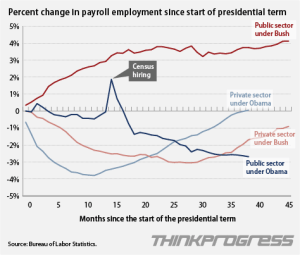
It makes Bush look like a socialist and Obama as a responsible business-friendly guy. I mean if Obama had the same public sector job growth we’d be hearing cries from Republicans that we have already arrived at socialism.
In other news: Bernanke was right, inflation hawks were wrong, as have been pointed out before in my blog.
“Herod: I’ll tell you what, I’ll be a Good Samaritan. What’s the cheapest gun you got? Not in a case. I mean the cheapest piece of worthless crap you have in the whole miserable store.
Kid: All right. (Brings out the cheapest gun and slams it on the counter). 5 bucks.
Herod: Sold!
Kid: (starts putting bullets in the gun)
Herod: What are you doing? Preacher here’s got the Lord on his side. He only needs one bullet. Just one. Otherwise he might be tempted to shoot his way out of town.”
The Quick and The Dead.
The current dynamics of the regulatory overhaul is a depressing development. While I’m normally quick to criticize regulators, and for good reason, I also have to admit that monetary deprivation of such agencies by Republicans, as evidenced by budget cuts for CFTC, place some blame on anti-regulatory forces in Congress. Regulators that are currently entrusted with the task of policing Wall Street are facing a well-funded, well-connected and politically shrewd beast.
In essence, regulators are not writing the rules for Wall Street. Wall Street is writing the rules for regulators.
A few months ago, for example, the CFTC was given the power to oversee derivatives and the futures markets. At the same time the Congress plans to cut $25M (a 12% cut form a year before) from CFTC budget in a time when they desperately need more resources to effectively accomplish their new responsibilities. The regulators have resource allocation problem that will prevent them from properly enforcing their mandate.
It is remarkable although not surprising that the most restrictive language in the bill came from Wall Street lobbyists. What’s more amusing is to hear the authors of the bill vying for fair and effective regulation, offering suggestions on how that sort of regulation should be achieved and then cutting funding that would undermine the implementation of those very suggestions. This is schizophrenic!
The new appropriations bill carves out very specific amounts to be spent on very specific assignments. For instance, the Republican lawmakers are absolutely certain that to update the crumbling IT infrastructure at CFTC would cost $32mln. The authors of the bill also demand that before regulators implement anything they must conduct a comprehensive quantitative analysis of the impact of the rules. Shouldn’t the public, by the same logic, demand that before lawmakers make such definitive decisions about how much money the regulatory agencies will need, they, too, should conduct a thorough analysis of the needs of those agencies? I am very curious to know how they came up with the figure of $32 mln to revamp the CFTC antiquated computer systems. Do they expect regulators to hire new IT personnel, buy new equipment, write/purchase new software, not just any software, but the kind that would effectively monitor a number of important markets, including high-frequency trading (HFT), an obscure but powerful Wall Street niche that commands the brightest minds and the thickest purse? And do they also expect the CFTC to conduct a thorough analysis of the possible consequences that may harm the business, a grotesque request in itself, and report the results to Congress in 30 days? And the most curious question of all, is Wall street ready to open their books and submit their HFT trading codes to regulators in order to ensure the analysis they themselves insisted upon is truly “thorough”? Are you, like me, suspecting that no matter what kind of results the CFTC submits, the Wall Street (via Congress) will never be satisfied?
I think it’s a brilliant business model for Wall Street. First, it doesn’t get any headlines – do you expect an average person to read anything that has ‘regulatory’ and ‘appropriations bill’ in it? Second, you can pass as many as 100 tough Dodd Frank bills and placate the public, but then quietly get to work on carving loopholes, exceptions and if that isn’t enough, just starve the damn beast of the funds! Wall Street arms itself with heavy sophisticated weaponry (no amount of money and resources are spared when building a high-frequency trading desk, it’s a multi-billion dollar business; and no amount of money is spared on lobbyists), then, with the complicit help of Republicans in Congress, they deliberately put themselves into position of handing out weaponry to their watchdog, and, surprise, hand him an old 19-century pistol. And then, to add insult to the injury, they also demand the watchdog to conduct an analysis, a thorough analysis, not just and “administrative check”, of what kind of harm that 19-century pistol can wreak on fragile Wall Street “lemonade stand”.
Even during Wild West times, so revered in American mythology as the time of true rugged individualism and unfettered capitalism, not even a conniving villain had the chutzpah to demand the sensitive treatment. If you love allegories, like I do, there’s a fitting scene from The Quick and The Dead, where Gene Hackman (Herod) is buying a gun for his dueling opponent Russell Crowe (Cort). Except that Herod doesn’t demand Cort to be gentle.
http://www.youtube.com/watch?v=6RdrYt1eFGk
Our regulators are no Cort. They have not been trained to shoot. Especially with one bullet.
Slightly shorter version of the longer article on my blog.
 Left with Balls